- The summit of Mount Rainier has an alpine climate.
[hide]Climate data for Mount Rainier (14,411 feet; 4,392 m) Month Jan Feb Mar Apr May Jun Jul Aug Sep Oct Nov Dec Year Average high °F (°C) 7
(−14)9
(−13)11
(−12)17
(−8)22
(−6)26
(−3)33
(1)32
(0)28
(−2)20
(−7)14
(−10)8
(−13)18.9
(−7.2)Average low °F (°C) −3
(−19)−2
(−19)−2
(−19)2
(−17)6
(−14)10
(−12)15
(−9)14
(−10)12
(−11)7
(−14)2
(−17)−2
(−19)4.9
(−15)Source: [82] See also
 Rainier in Reflection Lake
- List of mountain peaks of North America
- Bailey Willis, USGS geological engineer, played a key role in getting Mount Rainier designated as a national park, Willis Wall is named after him.[83]
References
- "Mount Rainier, Washington". Peakbagger.com. Retrieved January 1, 2016.
- "Mount Rainier". Geographic Names Information System. United States Geological Survey. Retrieved 2008-10-15.
- "Rainier". Global Volcanism Program. Smithsonian Institution. Retrieved 2008-08-27.
- Hill, Craig (2006-11-16). "Taking the measure of a mountain". The News Tribune. Archived from the original on 2006-11-16.
- Signani, PLS, Larry (2000-07-19). "The Height of Accuracy". Point of Beginning (trade magazine). BNP Media. Retrieved 2008-10-17.
- "Decade Volcanoes". CVO. United States Geological Survey. Archived from the original on 2012-07-20.
- Driedger, C.L.; Scott, K.M. (2005-03-01). "Mount Rainier – Learning to Live with Volcanic Risk". Fact Sheet 034-02. United States Geological Survey. Retrieved 2008-10-30.
- Clark, Ella E. (2003-02-03). Indian Legends of the Pacific Northwest. University of California Press. ISBN 0-520-23926-1.
- Beckey, Fred (January 2009). Cascade Alpine Guide. Vol.3 (3rd ed.). Mountaineers Books. ISBN 1-59485-136-0.
- "Is it time to rename Mount Rainier to its former native name?". Archived from the original on 2014-10-21.
- "Historical Notes: Vancouver's Voyage". Mount Rainier Nature Notes. VII (14). 1929. Retrieved 2015-02-03.
- Catton, Theodore (2006-11-30). National Park, City Playground: Mount Rainier in the Twentieth Century. A Samuel and Althea Stroum Book. Seattle, United States and London, United Kingdom: University of Washington Press. pp. 8–9. ISBN 0-295-98643-3.
- Winthrop, Theodore (1866). "VII. Tacoma". The canoe and the saddle : adventures among the northwestern rivers and forests, and Isthmiana (8th ed.). Boston: Ticknor and Fields. ISBN 0-665-37762-2. Retrieved 2009-03-04.
- Orth, Donald J. (1992). "The Creation" (PDF). Meridian. Map and Geospatial Information Round Table (2): 18. OCLC 18508074. Retrieved August 31, 2015.
- Blethen, C. B. (February 3, 1924). "Academic Dispute Flares Forth; Mount Rainier's Name at Issue". The Seattle Times.
- "The Outdoor World: Mt. Rainier's Name Stands". Recreation. Vol. LVII no. 3. Outdoor World Publishing Company. September 1917. p. 142. OCLC 12010285. Retrieved August 31, 2015 – via Google Books.
- Eaton, Nick (2014-02-01). "Mount Rainier renamed Mount Seattle Seahawks for Super Bowl XLVIII". The Seahawks Blog. Seattle Post-Intelligencer. Retrieved 2015-03-12.
- Pappas, Stephanie (2014-01-29). "Colorado's Highest Peaks Re-Named After Super Bowl Team". Live Science. Retrieved 2015-03-12.
- Seattle Times editorial board (2015-09-01). "After McKinley, it's time to consider renaming Rainier". Seattle Times. Retrieved 2015-09-01.
- "Mount Rainier". Peakbagger.com.
- "World Top 50 by Prominence". Peakbagger.com. Retrieved 2008-11-05.
- Bruce Barcott (1999-04-27). "The Mountain is Out". Western Washington University. Archived from the original on 2009-01-13. Retrieved 2007-03-23.
- "View of Rainier". Nature Spot. Archived from the original on 2009-11-03. Retrieved 2010-09-29.
- Topinka, Lyn (2002). "Mount Rainier Glaciers and Glaciations". United States Geological Survey.
-
 This article incorporates public domain material from the United States Geological Survey document: Driedger, C.L. "Glaciers on Mount Rainier". Retrieved 2010-04-21. (Open-File Report 92-474).
 - Zimbelman, D. R.; Rye, R. O.; Landis, G. P. (2000). "Fumaroles in ice caves on the summit of Mount Rainier; preliminary stable isotope, gas, and geochemical studies". Journal of Volcanology and Geothermal Research. 97 (1–4): 457–473. Bibcode:2000JVGR...97..457Z. doi:10.1016/S0377-0273(99)00180-8.
- Sandi Doughton (2007-10-25). "Exploring Rainier's summit steam caves". The News Tribune. Retrieved 2010-10-03.
- Kiver, Eugene P.; Mumma, Martin D. (1971). "Summit Firn Caves, Mount Rainier, Washington". Science. 173 (3994): 320–322. Bibcode:1971Sci...173..320K. doi:10.1126/science.173.3994.320. PMID 17809214.
- Kiver, Eugene P.; Steele, William K. (1975). "Firn Caves in the Volcanic Craters of Mount Rainier, Washington" (abstract only). The NSS Bulletin. 37 (3): 45–55.
- John Roper; Jeff Howbert. "Washington 100 Highest Peaks with 400 feet of prominence". The Northwest Peakbaggers Asylum. Retrieved 2007-03-23.
- "Little Tahoma Peak". Geographic Names Information System. United States Geological Survey. Retrieved 2008-11-25.
- "Little Tahoma". Mount Rainier National Park. Retrieved 2010-09-29.
- Wood, C.A.; Kienle, J. (1990). Volcanoes of North America: United States and Canada. Cambridge University Press. pp. 158–160. ISBN 0-521-36469-8.
- Sisson, T.W. (1995). History and Hazards of Mount Rainier, Washington. United States Geological Survey. Open-File Report 95-642.
- Scott, Kevin M.; Vallance, James W. (1993). "History of landslides and Debris Flows at Mount Rainier". Open-File Report 93-111. United States Geological Survey. Retrieved 2013-12-27.
- Parchman, F. (2005-10-19). "The Super Flood". Seattle Weekly. Archived from the original on 2007-03-21. Retrieved 2008-01-13.
- Crandall, D.R. (1971). "Postglacial Lahars From Mount Rainier Volcano, Washington". U.S. Geological Survey Professional Paper. 677.
- Harris, Stephen L. (2005). "Mount Rainier: America's Most Dangerous Volcano". Fire Mountains of the West (3rd ed.). Missoula, Montana: Mountain Press Publishing Company. pp. 299–334. ISBN 0-87842-511-X.
- "Mount Rainier Volcano". United States Geological Survey. 2007-04-27. Retrieved 2010-01-22.
- Handwerk, Brian (2003-09-25). "Rainier Eruption Odds Low, Impact High, Expert Says". National Geographic Ultimate Explorer.
- "Why Have Volcanoes in the Cascades Been So Quiet Lately?". Retrieved 2016-07-17.
- "Scientists eye Cascade range volcanoes". Retrieved 2016-07-17.
- "Mount Mazama and Crater Lake: Growth and Destruction of a Cascades Volcano". pubs.usgs.gov. Retrieved 2016-07-17.
- McNichols, Joshua. "What will happen when Mount Rainier erupts?". Retrieved 2016-07-17.
- Malone, S.D.; Moran, S.C. (1995). "Mount Rainier, Washington, USA - IAVCEI "Decade Volcano" - Hazards, Seismicity, and Geophysical Studies". IAVCEI conference on volcanic hazard in densely populated regions. Archived from the original on 1997-07-22.
- Tucker, Rob (2001-07-23). "Lahar: Thousands live in harm's way". Tacoma News Tribune. Archived from the original on 2012-07-20.
- Scott, K.M.; Vallance, J.W.; Pringle, P.T. (1995). "Sedimentology, Behavior, and Hazards of Debris Flows at Mount Rainier, Washington". Geological Survey Professional Paper 1547. United States Geological Survey.
- Hoblitt, R.P.; J.S. Walder; C.L. Driedger; K.M. Scott; P.T. Pringle; J.W. Vallance (1998). "Volcano Hazards from Mount Rainier, Washington, Revised". Open-File Report 98-428. United States Geological Survey.
- "Mount Rainier Debris-Flow Maps available from USGS". United States Geological Survey. Retrieved 2010-09-29.
- "Mount Rainier Volcano Lahar Warning System".
- "Volcanic Hazard Areas" (PDF). Critical Areas, Stormwater, and Clearing and Grading Ordinances. King County, Washington. Retrieved 2010-05-18.
- "Nevado del Ruiz". Global Volcanism Program. Smithsonian Institution. Retrieved 2010-06-01.
- "Paths of Destruction: The Hidden Threat at Mount Rainier". Geotimes. April 2004. Retrieved 2013-12-27.
- The Pacific Northwest Seismic Network (2006-12-07). "Mount Rainier Seismicity Information". Archived from the original on 2012-07-20. Retrieved 2011-05-28.
- Cascades Volcano Observatory (2006-09-23). "Mount Rainier Swarm Report". United States Geological Survey. Retrieved 2011-05-28.
- "Spate of quakes around Mount Rainier". The Seattle Times. 2011-10-17. Archived from the original on 2011-10-20.
- Doughton, Sandi (2015-08-14). "Rainier melting unleashes 'glacial outbursts' of debris". Seattle Times.
- Winsey, H. J. (1888). The Great Northwest. St Paul, MN: Northern News Co. frontispiece.
- "Mowich" is the Chinook Jargon word for "deer".
- Haines, Aubrey L. (1999) [1962]. Mountain fever : historic conquests of Rainier. Original publisher: Oregon Historical Society; Republished by University of Washington. ISBN 0-295-97847-3.
- "Hazard Stevens photographs, c. 1840s-1918". University of Oregon Libraries Historic Photograph Collections. University of Oregon. March 2006. Retrieved 2008-05-14.
- Bragg, Lynn (2010). More than Petticoats: Remarkable Washington Women (2nd ed.). Globe Pequot.
- "John Muir and Mount Rainier". Arthur Churchill Warner Photographs. 2010. Retrieved 2010-09-29.
- "U.S. Code: Title 16 Chapter 1 Subchapter XI § 91". Legal Information Institute, Cornell University Law School. Retrieved 2008-10-30.
- "U.S. Code: Title 16 Chapter 1 Subchapter XI § 92". Legal Information Institute, Cornell University Law School. Retrieved 2008-10-30.
- Driedger, C.L.; Scott, W.E. (2008). "Mount Rainier - Living Safely With a Volcano in Your Backyard". United States Geological Survey. Retrieved 2010-09-30.
- US Stamps Commemoratives of 1934-1935
- "Washington State Quarter". Washington State Arts Commission. Archived from the original on 2012-07-20. Retrieved 2010-05-07.
- Green, Sara Jean (2007-04-12). "Washington quarter makes debut". The Seattle Times. Retrieved 2007-04-12.
- "MORA Climbing Statistics". National Park Service. 2005-07-30. Archived from the original on 2006-01-01.
- "Camp Muir, Mount Rainier, Washington". University of Washington Libraries Digital Collections. University of Washington. Retrieved 2007-09-12.
- "Mt. Rainier Climbing Pass FAQs". National Park Service. Retrieved 2014-01-25.
- "Climbing Mount Rainier" (PDF). National Park Service. Retrieved 2014-02-05.
- Hatcher, Candy (2000-03-30). "Ghosts of Rainier: Icefall in 1981 entombed 11 climbers". The Seattle Post-Intelligencer. Retrieved 2008-11-09.
- "HistoryLink: A Curtis Commando R5C transport plane crashes into Mount Rainier, killing 32 U.S. Marines, on December 10, 1946". HistoryLink.org. 2006-07-29. Retrieved 2008-11-09.
- "Ranger plunges to death on Mount Rainier". CNN. 2012-06-22. Retrieved 2013-12-27.
- Llanos, Miguel (2012-06-22). "Park ranger falls 3,700 feet to death during Mount Rainier rescue". NBC News. Retrieved 2013-12-27.
- "6 climbers dead on Mount Rainier". The Seattle Times. Retrieved 2014-05-29.
- John de Leon (2014-08-20). "Bodies of 3 missing climbers recovered from Mount Rainier". The Seattle Times. Retrieved 2014-09-02.
- Paige Cornwell (2014-08-22). "Bodies of 3 Mount Rainier climbers identified". The Seattle Times. Retrieved 2014-09-02.
- "Backcountry Skiing Guide to Mount Rainier, Washington". Retrieved 2010-04-10.
- "Interesting Weather Statistics for US Mountain Summits". SummitPost. Retrieved 2013-07-07.
Friday, April 7, 2017
Climate


Climbing and recreation
Mountain climbing on Mount Rainier is difficult, involving traversing the largest glaciers in the U.S. south of Alaska.
Most climbers require two to three days to reach the summit. Climbing
teams require experience in glacier travel, self-rescue, and wilderness
travel. About 8,000 to 13,000 people attempt the climb each year,[70] about 90% via routes from Camp Muir on the southeast flank.[71] Most of the rest ascend Emmons Glacier
via Camp Schurman on the northeast. About half of the attempts are
successful, with weather and conditioning being the most common reasons
for failure. All climbers who plan to climb above high camps, Camp Muir and Camp Schurman, are required by law to purchase a Mount Rainier Climbing Pass and register for their climb.[72]
Additionally, solo climbers must fill out a solo climbing request form
and receive written permission from the Superintendent before attempting
to climb.[73]
The worst mountaineering accident on Mount Rainier occurred in 1981, when eleven people lost their lives in an ice fall on the Ingraham Glacier.[74] This was the largest number of fatalities on Mount Rainier in a single incident since 32 people were killed in a 1946 plane crash on the South Tahoma Glacier.[75]
More recently, the mountain received media attention in 2012, as one of the park rangers lost his life when several climbers were caught in a storm while trying to ascend the mountain. While trying to help load the climbers into a rescue helicopter, the ranger lost his footing, and slid 3,700 feet (1,100 m) to his death.[76][77]
In one of the worst disasters on the mountain in over thirty years, six climbers—two guides, and four clients—last heard from on May 28, 2014, were presumed dead on May 31, 2014, when low-flying search helicopters pinged the signals from the avalanche beacons worn by the climbers. Officials concluded that there was no possible chance of survival after the climbers fell 3,300 feet (1,000 m) while attempting or returning from the summit via the Liberty Ridge climbing route. Searchers found tents and clothes along with rock and ice strewn across a debris field on the Carbon Glacier at 9,500 ft (2,900 m), possible evidence for a slide or avalanche in the vicinity where the team went missing, though the exact cause of the accident is unknown.[78] The bodies of three of the guest climbers were spotted on August 7, 2014, during a training flight and subsequently recovered on August 19, 2014. The bodies of the fourth guest climber and two guides have not been located.[79][80]
About two mountaineering deaths each year occur because of rock and ice fall, avalanche, falls, and hypothermia associated with severe weather (58 reported since and including the 1981 accident through 2010 per American Alpine Club Accidents in North American Mountaineering and the NPS).
Hiking, backcountry skiing, photography, and camping are popular in the park. Hiking trails, including the Wonderland Trail—a 93-mile or 150-kilometre circumnavigation of the peak—provide access to the backcountry. Mount Rainier is also popular for winter sports, including snowshoeing and cross-country skiing.[81]
The worst mountaineering accident on Mount Rainier occurred in 1981, when eleven people lost their lives in an ice fall on the Ingraham Glacier.[74] This was the largest number of fatalities on Mount Rainier in a single incident since 32 people were killed in a 1946 plane crash on the South Tahoma Glacier.[75]
More recently, the mountain received media attention in 2012, as one of the park rangers lost his life when several climbers were caught in a storm while trying to ascend the mountain. While trying to help load the climbers into a rescue helicopter, the ranger lost his footing, and slid 3,700 feet (1,100 m) to his death.[76][77]
In one of the worst disasters on the mountain in over thirty years, six climbers—two guides, and four clients—last heard from on May 28, 2014, were presumed dead on May 31, 2014, when low-flying search helicopters pinged the signals from the avalanche beacons worn by the climbers. Officials concluded that there was no possible chance of survival after the climbers fell 3,300 feet (1,000 m) while attempting or returning from the summit via the Liberty Ridge climbing route. Searchers found tents and clothes along with rock and ice strewn across a debris field on the Carbon Glacier at 9,500 ft (2,900 m), possible evidence for a slide or avalanche in the vicinity where the team went missing, though the exact cause of the accident is unknown.[78] The bodies of three of the guest climbers were spotted on August 7, 2014, during a training flight and subsequently recovered on August 19, 2014. The bodies of the fourth guest climber and two guides have not been located.[79][80]
About two mountaineering deaths each year occur because of rock and ice fall, avalanche, falls, and hypothermia associated with severe weather (58 reported since and including the 1981 accident through 2010 per American Alpine Club Accidents in North American Mountaineering and the NPS).
Hiking, backcountry skiing, photography, and camping are popular in the park. Hiking trails, including the Wonderland Trail—a 93-mile or 150-kilometre circumnavigation of the peak—provide access to the backcountry. Mount Rainier is also popular for winter sports, including snowshoeing and cross-country skiing.[81]
Human history
At the time of European contact, the river valleys and other areas near the mountain were inhabited by many Pacific Northwest tribes who hunted and gathered berries in its forests and mountain meadows. These included the Nisqually, Cowlitz, Yakama, Puyallup, and Muckleshoot.[citation needed]
Captain George Vancouver reached Puget Sound in early May 1792 and became the first European to see the mountain.[11]
In 1833, Dr. William Fraser Tolmie explored the area looking for medicinal plants. Hazard Stevens and P. B. Van Trump received a hero's welcome in the streets of Olympia after their successful summit climb in 1870.[60][61] The first female ascent was made in 1890 by Fay Fuller, accompanied by Van Trump and three other teammates.[62]
John Muir climbed Mount Rainier in 1888, and although he enjoyed the view, he conceded that it was best appreciated from below. Muir was one of many who advocated protecting the mountain. In 1893, the area was set aside as part of the Pacific Forest Reserve in order to protect its physical and economic resources, primarily timber and watersheds.[63]
Citing the need to also protect scenery and provide for public enjoyment, railroads and local businesses urged the creation of a national park in hopes of increased tourism. On March 2, 1899, President William McKinley established Mount Rainier National Park as America's fifth national park. Congress dedicated the new park "for the benefit and enjoyment of the people"[64] and "... for the preservation from injury or spoliation of all timber, mineral deposits, natural curiosities, or wonders within said park, and their retention in their natural condition."[65]
 In 1998, the United States Geological Survey began putting together the Mount Rainier Volcano Lahar Warning System to assist in the emergency evacuation of the Puyallup River valley in the event of a catastrophic debris flow. It is now run by the Pierce County Department of Emergency Management. Tacoma, at the mouth of the Puyallup, is only 37 mi (60 km) west of Rainier, and moderately sized towns such as Puyallup and Orting are only 27 and 20 mi (43 and 32 km) away, respectively.[66]
Mt. Rainier appears on four distinct United States postage stamp issues. In 1934, it was the 3-cent issue in a series of National Park stamps, and was also shown on a souvenir sheet issued for a philatelic convention. The following year, in 1935, both of these were reprinted by Postmaster General James A. Farley as special issues given to officials and friends. Because of complaints by the public, "Farley's Follies" were reproduced in large numbers. The second stamp issue is easy to tell from the original because it is imperforate. Both stamps and souvenir sheets are widely available.[67]
The Washington state quarter, which was released on April 11, 2007, features Mount Rainier and a salmon.[68][69]
Captain George Vancouver reached Puget Sound in early May 1792 and became the first European to see the mountain.[11]
In 1833, Dr. William Fraser Tolmie explored the area looking for medicinal plants. Hazard Stevens and P. B. Van Trump received a hero's welcome in the streets of Olympia after their successful summit climb in 1870.[60][61] The first female ascent was made in 1890 by Fay Fuller, accompanied by Van Trump and three other teammates.[62]
John Muir climbed Mount Rainier in 1888, and although he enjoyed the view, he conceded that it was best appreciated from below. Muir was one of many who advocated protecting the mountain. In 1893, the area was set aside as part of the Pacific Forest Reserve in order to protect its physical and economic resources, primarily timber and watersheds.[63]
Citing the need to also protect scenery and provide for public enjoyment, railroads and local businesses urged the creation of a national park in hopes of increased tourism. On March 2, 1899, President William McKinley established Mount Rainier National Park as America's fifth national park. Congress dedicated the new park "for the benefit and enjoyment of the people"[64] and "... for the preservation from injury or spoliation of all timber, mineral deposits, natural curiosities, or wonders within said park, and their retention in their natural condition."[65]

Mt. Rainier appears on four distinct United States postage stamp issues. In 1934, it was the 3-cent issue in a series of National Park stamps, and was also shown on a souvenir sheet issued for a philatelic convention. The following year, in 1935, both of these were reprinted by Postmaster General James A. Farley as special issues given to officials and friends. Because of complaints by the public, "Farley's Follies" were reproduced in large numbers. The second stamp issue is easy to tell from the original because it is imperforate. Both stamps and souvenir sheets are widely available.[67]
The Washington state quarter, which was released on April 11, 2007, features Mount Rainier and a salmon.[68][69]
Seismic background
Typically, up to five earthquakes are recorded monthly near the
summit. Swarms of five to ten shallow earthquakes over two or three days
take place from time to time, predominantly in the region of 13,000
feet (4 km) below the summit. These earthquakes are thought to be caused
by the circulation of hot fluids beneath Mount Rainier. Presumably, hot
springs and steam vents within Mount Rainier National Park are generated by such fluids.[54]
Seismic swarms (not initiated with a mainshock) are common features at
volcanoes, and are rarely associated with eruptive activity. Rainier has
had several such swarms; there were days-long swarms in 2002, 2004, and
2007, two of which (2002 and 2004) included M 3.2 earthquakes. A 2009
swarm produced the largest number of events of any swarm at Rainier
since seismic monitoring began over two decades earlier.[55] Yet another swarm was observed in 2011.[56]

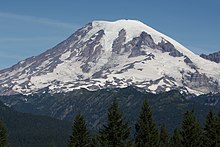 Glaciers
are among the most conspicuous and dynamic geologic features on Mount
Rainier. They erode the volcanic cone and are important sources of
streamflow for several rivers, including some that provide water for hydroelectric power and irrigation. Together with perennial snow patches, the 26 major glaciers cover about 36 square miles (93 km2) of the mountain's surface and have a volume of about 1 cubic mile (4.2 km3).[24][25]
Glaciers
are among the most conspicuous and dynamic geologic features on Mount
Rainier. They erode the volcanic cone and are important sources of
streamflow for several rivers, including some that provide water for hydroelectric power and irrigation. Together with perennial snow patches, the 26 major glaciers cover about 36 square miles (93 km2) of the mountain's surface and have a volume of about 1 cubic mile (4.2 km3).[24][25]
Glaciers flow under the influence of gravity by the combined action of sliding over the rock on which they lie and by deformation, the gradual displacement between and within individual ice crystals. Maximum speeds occur near the surface and along the centerline of the glacier. During May 1970, Nisqually Glacier was measured moving as fast as 29 inches (74 cm) per day. Flow rates are generally greater in summer than in winter, probably due to the presence of large quantities of meltwater at the glacier base.[25]
The size of glaciers on Mount Rainier has fluctuated significantly in the past. For example, during the last ice age, from about 25,000 to about 15,000 years ago, glaciers covered most of the area now within the boundaries of Mount Rainier National Park and extended to the perimeter of the present Puget Sound Basin.[25]
Between the 14th century and 1850, many of the glaciers on Mount Rainier advanced to their farthest extent downvalley since the last ice age. Many advances of this sort occurred worldwide during this time period known to geologists as the Little Ice Age. During the Little Ice Age, the Nisqually Glacier advanced to a position 650 to 800 ft (200 to 240 m) downvalley from the site of the Glacier Bridge, Tahoma and South Tahoma Glaciers merged at the base of Glacier Island, and the terminus of Emmons Glacier reached within 1.2 mi (1.9 km) of the White River Campground.[25]
Retreat of the Little Ice Age glaciers was slow until about 1920 when retreat became more rapid. Between the height of the Little Ice Age and 1950, Mount Rainier's glaciers lost about one-quarter of their length. Beginning in 1950 and continuing through the early 1980s, however, many of the major glaciers advanced in response to relatively cooler temperatures of the mid-century. The Carbon, Cowlitz, Emmons, and Nisqually Glaciers advanced during the late 1970s and early 1980s as a result of high snowfalls during the 1960s and 1970s. Since the early-1980s, however, many glaciers have been thinning and retreating and some advances have slowed.[25]
The glaciers on Mount Rainier can generate mudflows, through glacial outburst floods not associated with any eruption. The South Tahoma Glacier generated 30 floods in the 1980s and early 1990s, and again in August, 2015.[57]
Glaciers

Three-dimensional representation of Mount Rainier

Nisqually Glacier is seen clearly from the southeast of the mountain.
Glaciers flow under the influence of gravity by the combined action of sliding over the rock on which they lie and by deformation, the gradual displacement between and within individual ice crystals. Maximum speeds occur near the surface and along the centerline of the glacier. During May 1970, Nisqually Glacier was measured moving as fast as 29 inches (74 cm) per day. Flow rates are generally greater in summer than in winter, probably due to the presence of large quantities of meltwater at the glacier base.[25]
The size of glaciers on Mount Rainier has fluctuated significantly in the past. For example, during the last ice age, from about 25,000 to about 15,000 years ago, glaciers covered most of the area now within the boundaries of Mount Rainier National Park and extended to the perimeter of the present Puget Sound Basin.[25]
Between the 14th century and 1850, many of the glaciers on Mount Rainier advanced to their farthest extent downvalley since the last ice age. Many advances of this sort occurred worldwide during this time period known to geologists as the Little Ice Age. During the Little Ice Age, the Nisqually Glacier advanced to a position 650 to 800 ft (200 to 240 m) downvalley from the site of the Glacier Bridge, Tahoma and South Tahoma Glaciers merged at the base of Glacier Island, and the terminus of Emmons Glacier reached within 1.2 mi (1.9 km) of the White River Campground.[25]
Retreat of the Little Ice Age glaciers was slow until about 1920 when retreat became more rapid. Between the height of the Little Ice Age and 1950, Mount Rainier's glaciers lost about one-quarter of their length. Beginning in 1950 and continuing through the early 1980s, however, many of the major glaciers advanced in response to relatively cooler temperatures of the mid-century. The Carbon, Cowlitz, Emmons, and Nisqually Glaciers advanced during the late 1970s and early 1980s as a result of high snowfalls during the 1960s and 1970s. Since the early-1980s, however, many glaciers have been thinning and retreating and some advances have slowed.[25]
The glaciers on Mount Rainier can generate mudflows, through glacial outburst floods not associated with any eruption. The South Tahoma Glacier generated 30 floods in the 1980s and early 1990s, and again in August, 2015.[57]
Subscribe to:
Posts (Atom)